
An AI Crash May Allow Net Zero
Following growing anxiety internationally we are seeing a fall in the values of Big Tech companies which have borrowed from banks very large sums guaranteed against their stock market values. Dr Stephen Dealler, former professor in medicine and a businessman looks at the economics of such a crash and the discussion already in progress.
Booms and crashes have been known to occur when low interest rates lead to inflation (e.g. subprime mortgage 2009). It is also seen when borrowing at market interest rates by large corporations is used to spend on investment growth. That is a risk to the corporation if it not followed by an adequate return for this investment (ROI) to pay the ongoing cost of that borrowing (e.g. the Great Crash 1929). When interest annual percentage rates rise again due to inflation, it suddenly becomes clear that the original borrowing could not be repaid, and the value of the corporation’s stock drops dramatically.
The Great Crash on Wall Street (1929) saw a long period of relative prosperity after the first war, to be followed by shares rising and banks lending money, often to their own subcontractors or individuals in order for them to buy more shares. The subsequent spiral of rising share prices could not be justified forever. Banks realised that their returns from lending were worth less than they had originally loaned. Quickly, individuals and banks tried to sell their shares, failing, and this triggering a long period of difficulty for money borrowing because as lender would not accept poorly valued stocks as a guarantee. (Galbraith, 1929). The second war, with massive Government spending halted this crash altogether. The expansive spending made it worthwhile for bankers to lend to companies that would be producing products for the second war (e.g. guns, tanks etc) and investment in those companies through public offering of shares. Money would come through to higher wages and low unemployment, which would spread Government spending widely in economy.
This apprent answer to a bubble and crash became standard consideration as Keynesian spending, which would be used to expand the economy. However, at later dates its was realised that this also expanded the economy of all other countries at the same time simply by sucking in foreign imports. As such it was realised that some kind of balance was always necessary between massive spending any long term damage it might do. This monetaristic approach is now also considered.
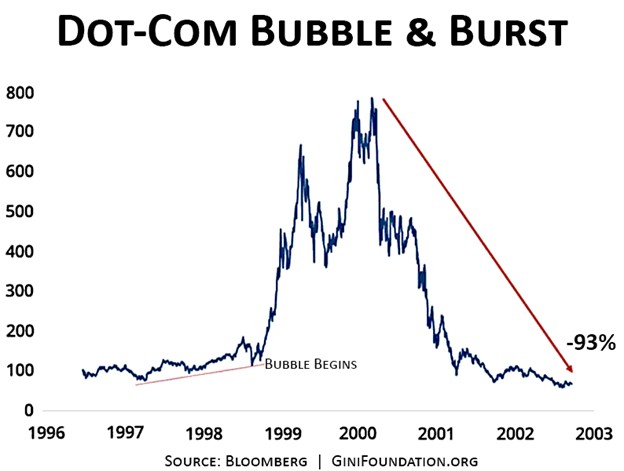
The Dot-Com bubble (early 1990s) took place as computerization by individuals was making it cheaper for individuals to buy on-line. The imagined damage that this would do to retail sales caused many investors to change over from retail to computerized selling. At the time this simply was not ready for the market at all, and money in many jumped-up companies just were shown to be valueless. But the money had been spent often by the City seeing little Return on Investment (ROI). This was particularly clear in the UK.
The sub-prime mortgage bubble (2009) was caused by low interest rates and the possibility of lending money to potential house buyers as mortgages when a few of these buyers, if defaulting, could be covered by plenty more that had more money than needed to cover those bank losses. The rise in interest rates saw a much larger proportion unable to pay the mortgage and throwing in their house keys to the mortgage lender. House prices crashed and a growing number of mortgages could not be covered even by the value of the house itself. Lehman Brothers was the biggest coverer of other lenders so itself went bust. This was mainly in the U.S. but the UK was badly affected when building societies had followed the same path.
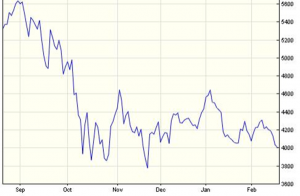
Stock Market 2008
The AI bubble would happen because the Big Tech companies are largely borrowing cheap money with guarantees against the company value for the creation of Data Hubs, energy creation, and infrastructure. Many estimates are seen of this spending but Dr Inglesant’s figures suggesting around $8 Tr (25% of annual GDP in USA and about twice that of UK GDP) and not seeing adequate returns at least past 2034 due to demands for regulation. There is a widespread demand that regulation of AI in the EU, which took place in 2025, and, in the UK to follow would appear in the US. However similar regulation in many US states was stopped by Trump through an Executive Order (EO). What is expected is that if Trump loses much of his power in the US many states will follow the EU and UK in this regulation. It should be noted that although AI could indeed be extremely useful, it could be used for military, crime, political, and ultra-policing systems. That would require regulation as has been demanded by Anthropic, which would not let their AI programs to be used by Trump for processes considered unethical. Trump has now banned Anthropic from any Governmental work.
Currently it is difficult the calculate the costs of a Data Hub itself, which may need much of its electronic infrastructure replaced every 5-6 years. Clearly the borrowing and spending of this amount represents only 4% of the value of the Wall St market itself, but puts back into the pockets of the workers that are creating the systems the money that represents a much higher percentage of retail turnover and inflation. At the moment we are seeing interests remaining fairly low in the US because Trump hired Federal Reserve Chairman (FRC) Kevin Warsh (that decides the interest rate) because Trump has indicated to him that no rise was wanted by industry. This led to a fall in the value of the dollar currently and for inflation to continue. The FRC, after the Trump presidency, would increase interest rates and it would be extremely expensive for the Big Tech to afford their debts. Already the share price for Microsoft has dropped by 10%, but the share value would allow Public Offerings (IPOs) of new shares to cover the debt. However, there has been a rise in personal income in the USA up until now due to the huge borrowed spending for AI and many shares with nothing to do with AI have seen their shares also rise. If the AI spending suddenly stopped it would lead to a much greater drop in many share prices on Wall St. So, stopping Data Hub borrowing-and-spending will see worldwide share falls. Many advisory investors are putting their money into gold or cash already….and hoping for action. Dr Inglesant (see references) tries to understand any economic, political or responsible action that have been taken
References:
- Dr Phillip Inglesant. Responsible AI: are governments and corporations giving up? Responsible Science 2025; 7:23-25 . Responsible Science no. 7 | SGR: Responsible Science
- Galbraith JK. The Great Crash1929. Published by Penguin Books 1954. London
- Galbraith JK. A History of Economics. The Past and the Present. Published by Penguin Books1987.
- Keynes, John Maynard (1998). The Collected Writings of John Maynard Keynes (30 volume hardback ed.).: Cambridge University Press. ISBN 978-0521307666. Insight in Wikipedia.
- Friedman M, Schwartz A. A Monetary History of the United States, 1867–1960. Princeton University Press 1960.